
Confetti
Originally uploaded by bastchild.

I had arrived in Guadassuar to meet up with Emily and her family. Her grandparents were also celebrating their 50th wedding anniversary and retaking their vows. It was great hanging out in a small Spanish village devoid of tourists and tourist prices. Spain is remarkably inexpensive even with being part of the EU.
Ironically, we went to a Chinese restaurant in the nearby town of Alzira, where I ordered some of the dishes and asked the waiters to prepare the dishes in a more authentic way.

From Bern, I took the overnight train to Barcelona. I enjoyed a luxrious couchette, a sleeping car, and awoke refreshed in Barcelona's morning heat. I have been travelling without a Eurail pass, which has turned out to be fine since I never spend enough on my train travel to warrant a pass. It is interesting, however, that if you can book them earlier enough, travelling by air can be a cheaper way to get around Europe.

I arrived in this small village near Valencia. It is hot but less humid than in central Europe.

Bern's old quarter is filled with shopping arcades that all seem to be Coop and Migros stores, McDonald's and Burger King, and branches of H&M.

These kids were running around screaming and playing in the public fountain. One kid was trying to give himself an enema.

This can be seen from a park in Interlaken. It also happens to be the landing spot for the hundred paragliders that take off from the cliffs above.

Fountains and water troughs are abound in Switzerland. They offer refreshing and clean drinking water -- a much appreciated relief during the summer heat.

I saw farmers cut these fields of fallow with sickles and rake them by hand. Switzerland is country with one foot in the modern world and one foot in the last century.

All over the Gimmelwald region are cows with udders that are about to burst.

I descended the summit down the ski trail, which was muddy with snow.

It took me four hours to get to the summit of Schlithorn (2970 m) via my trail. The summit has a revolving restaurant and a theater showing clips from "Her Majesty's Secret Service". The movie is terribly cheesy, and the restaurant blows up in the end. It's a shame because there is actually pretty good food at the restaurant, which takes about an hour to revolve 360 degrees.

I had to hike this ridge to get to Schlithorn. Not in the direction of this photo, though.

I went hiking on my full day in Gimmelwald. I hiked to the top of Schlithorn, which is where they shot the end of that 007 movie, "Her Majesty's Secret Service". The trails are all well posted in this area. I had to cross through fenced grazing areas, closing gates behind me. Cowbells and the rush of meltwater fill the air in Gimmelwald.

This is the view from Mountain Hostel in Gimmelwald.
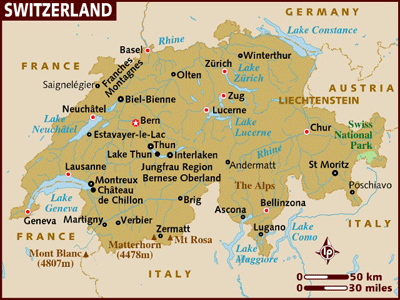 I had an overnight train ride to Switzerland from Slovenia. When I woke up from my cramped seat, I saw the sky lightening to reveal steep craggy peaks outside my window. I went to Gimmelwald, a village south of Interlaken, in the mountains. Interlaken was pretty and very posh. I paid 11.50 SF (1.2 SF = $1) for 30 minutes on the internet. Gimmelwald, on the otherhand, is really a cluster of farm homes on steep grassy terrain and a few pensions. There's a school there and that's about it. I had to take a gondola to get up there. The hostel was full of North Americans who all thought it was the best hostel in the world. It was full of flies for some reason, so I didn't feel the same. The views, however, were fantastic.

There was a National Geographic exhibit in town and they had photos from Slovenia from 1970. Lake Bled looked exactly the same.

An hour north of Ljubljana is the beautiful lake and town of Bled. It has a castle on a cliff and a small cathedral on an island. Peaceful and cooler, even the weekend crowds can't ruin a visit to this town. I visited during the day, before my night train to Switzerland.
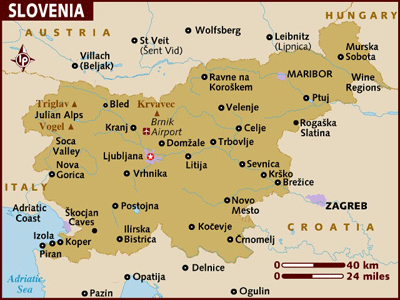 Slovenia is another former republic of Yugoslavia, along with Serbia & Montenegro, Bosnia - Hercegovina, Macedonia, and Croatia. It had a relatively quick 10-day revolution and has emerged scathfree from communism. Ljubljana is small and beautiful with close proximity (about an hour or less) to the coast, mountains, skiing, and "western Europe". Two summers ago, the downtown area was devoid of tourists, but it has been discovered, and more and more tourists have been showing up. All in all, however, it is nothing like western European cities in the summer time.

I was walking across a bridge in the old town when I heard someone calling my name. It was Jenny, the British medical student I met in Mae Sot in May 2005. She had just graduated from medical school and was travelling in the Balkans for a few weeks. We had only a short time to catch up before her train to Croatia. It's a small world.

I took an overnight bus from Sarajevo to Ljubljana, the capital of Slovenia. It was wonderfully air-conditioned. The bus slowly crept along small roads until it reached the Croatian border. From there to Ljubljana, we sped on a multi-laned highway. The passport control officers were pretty lax about stamping passports.

Melanie was from Perth, Australia. She was a surgical nurse working in Belfast, Ireland, but she had spent the last few months teaching NATO soldiers how to dive in Croatia. Javier, a Spaniard, whom I met on the bus from Belgrade, was a clinical psychologist helping battered women. We had drinks and dinner from a hill above the old city.

I coincidentally visited this site on the 92nd anniversary of the start of World War 1.

Serbian forces occupied the surrounding hills and used this to their advantage with 50 tanks and snipers. Sniper alley was an area around the Holiday Inn Hotel (the yellow building), occupied by foreign journalists, that was within range of snipers that camped out in the Jewish cemetery.

The story of Sarajevo in the 1990's, is a sad story of a city surrounded by Serbian troops and tanks. I took a day tour which was fascinating and informative, especially with heart-wrenching personal accounts by Sonny, the guide, who was 13 years old at the time.
The tour started at the Tunnel Museum, which was at the site of a tunnel that ran for 800 meters under the airfield, to Bosnian territory. For three years, this was the lifeline for the citizens of Sarajevo. UN planes that were allowed to land at the airport only brought 300 grams of food per person per day in Sarajevo, and half their payload had to be given to Serbian forces.

Scarred cement from mortar explosions. These "roses" remain as memorials for those who died at these sites. They are scattered throughout the city with a plaque on a wall with the date and number of people who died there.


