
Miljacka river
Originally uploaded by bastchild.
 A seven-hour sticky bus ride from Belgrade brought me to Sarajevo. I saw the beautiful red-tiled rooftops of the city from a mountain ridge, but then the bus dove down the other side of the mountain and stopped at a bus station in a village. It turns out that the buses to and from Serbia stop at a Serbian bus station outside of town. It reminded me a bit of the division in Jerusalem between the Israelis and Palestinians.
Crossing the Drina river brought me to Bosnia-Hercegovina. I ended up holding up the bus for an hour as the immigration officials were confused with the legitimacy of my supplemental pages taped into my passport.
 I arrived in Belgrade (Beograd) stiff from the dry crust of brine on my skin from the days long sweat at 2230h. It was not what I expected. It is modern, clean, and safe. There is a good night life here everynight of the week.
The train stopped for about two hours at a small town. I don't know what was wrong, but everyone lounged around on the tracks. I decided to change seats and moved to a different train car. It didn't have air conditioning, but it had windows that opened, which was much nicer.

After five nights in Budapest, I headed south for Belgrade, the former capital of the former republic of Yugoslavia. The weather has been in the 90's all week, and the broken air-conditioning unit in my car didn't help.

Thermal springs are everywhere in Budapest. This one in Varosliget (city park) is one of the more famous ones. They offer medicinal massages, thermal baths, and swimming.

Constructed to honor the millennial anniversary of the Magyar (Hungarian) conquest of the Carpathian Basin in 1896, it sits between to museums and the entrance to the city park.

No longer a palace, this place has a few museums. At the time, they were preparing for El Jefe's visit.

Budapest, the capital of Hungary, is actually two cities, the hilly western city of Buda (with it's two hills of Gellert and Varhegy) and the flat downtown section of Pest. It huddles around the Danube. Remarkably it has beautiful buildings that are not reminescent of communism.

Arriving in Budapest, I was faced with this beautiful building. As it turns out, a lot of Budapest has this turn-of-the-century architecture.
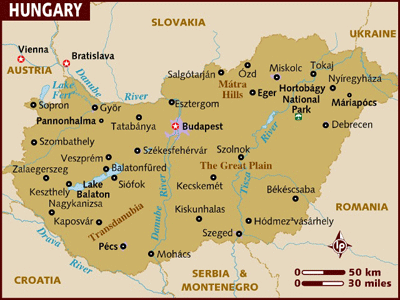 I have arrived a day before El Jefe Bush's visit to Budapest. What a coincidence! This is a modern city with beautiful buildings. Things are more expensive than in Romania (my hostel is almost $20/night), and there are even more young backpackers, partying through Europe. I'm off to see what the city holds.

By entering Hungary, I am officially in the European Union, and it shows. The roads and homes are very modern. It looks expensive, but Hungary still uses it's own currency, so it's not as expensive as the rest of the EU nations on the Euro. Romanian and Bulgaria will join the EU next year.

Train border crossings are much less exciting than walking on foot. Customs officials searched the overhead panels in the train cars for contraband. No one asked me to carry cigars as there was no duty free shop.

Unsurprisingly, we didn't see and vampires or undead, and we made it back to the hostel without a scratch. I blame it on the garlic.

I decided to visit the cemetery after midnight with some people. This photo is on the street at the bottom of the hill, outside the cemetary.

On the top of the hill in the citadel of Sighisoara is a German cemetary. Inside were a few wierd looking old caretakers tending to the weeds growing around the tombs with shovels and hoes. They sprinkled a clear liquid from used water bottles on the ground in some places. As I walked through they gave me a suspicious eye, then I stumbled upon this crypt. I'm not sure what to make of it.
No, I am not making any of this up.

I took this on the train ride back to Sighisoara from Brasov. It has been raining a little every other day for the past couple of weeks. The weather has been getting increasingly muggier and muggier.

Two hours from Sighisoara is Brasov, where most tourists stay. It is a bigger town that looks like it should be in Bavaria. I spent the afternoon here doing nothing as I had arrived too late to get to any castles.

Nathan's Villa Hostel in Sighisoara was pretty quiet, but the four of us went out for dinner in the citadel. Marc (proudly introducing himself as a Catalonian) had spent two weeks visiting friends in the far northeast of Romania living in the rural countryside. Mary (hailing from Wisconsin via Chicago) was headed to a two-week archeology course somewhere in Romania, and Ben (well, what can I say of this conversation-hijacking Brit?) was on a "Gap Year" before heading off to Oxford University to study "Medieval Literature" ("because that's my 'thing'").

The young Mr. Tepes was the son of the Voivode, or governor, of Wallachia, a Vlad Dracul (he was granted the Order of the Dragon, or "Dracul"), but was sent off by his father at the age of 6 to become a hostage in Turkey for the Sultan. It is said that it was from the Turks that young Mr. Tepes learned his preferred method of execution, i.e. impalement. Impalement meant a stake would be driven through the torso, some say via the rectum, but avoiding major organs so that the victim would be stuck on a post, feet dangling above the ground, helplessly, for two days until death came from slow hemorrhage. Legends say that he impaled the work avoidant as well as the elderly and disabled. He impaled thieves and robbers. It is said that when Sultan Mehmet II and the Ottoman army entered Wallachia, central Romania, to invade, they came across a "forest" of 20,000 impaled Turkish and Bulgarians. They retreated in disorder.

These ladies were by the caretaker's cottage at the top of the town.

The citadel sits high above the surrounding area. A church sits on a peak even higher than the rest of the citadel.

From Bucharest, I took a train to Transylvania, stopping in the small town of Sighisoara. It is supposed to be the birthplace of Vlad Tepes, whom later was known as Vlad the Impaler, whom Bram Stoker then fictionally made his "Dracula". A lot of the tourism in Romania is based around Transylvania and the legend of Dracula. I walked into a store in Sighisoara looking for postcards and there were two women. One woman spoke to me and showed me the postcards, but the other one stood near the entrance to the store, just inside, away from the sunlight. I swear she had sharpened incisors, had high cheekbones, and was wearing a high-collared shirt and jacket on a hot day. Moments later, as I was walking down the street I saw abnormally pale-looking laborers bringing loads into a renovated building. All the other laborers in this country are wrinkly and very tan. Legend or not, I added plenty of garlic to my pasta dinner that night.

Roma, or gypsies, came from northern India and arrived in 1407. Some of them were enslaved, and most were persecuted in some fashion. They remain as one of Europe's largest minorities with no country. A very strange and sad group of folks.

In 1984 construction began on this massive building under the order of Nicolae Ceaucescu, the former Romanian communist leader. It remains uncompleted today, however it does house the parliament and functions as a government building. It is the second largest building in the world (after the Pentagon).

This huge fountain encircles a roundabout in Bucharest. It also marks the end of the B-dul Unirii, the Champs Elysee-like boulevard that extends from the Palace of Parliament. It is actually a bit longer and wider than the Parisian street.

In December of 1989, Romania's communist regime collapsed, but not before tanks rolled over protesters and freedom fighters in this square.
 I finally left Veliko Tarnovo and headed north to Romania, leaving Bulgaria behind. Bulgaria was wonderfully cheap and quiet and untouristy even in its most touristy areas. I never quite got used to the headshaking meaning "yes" and the nods meaning "no's", but I was only there for a few days. The streets were full of new imports but also old Ladas, a reminder from not so long ago. Men were buffed out on steroids and lanky women strolled down the sidewalks as if they were catwalks.
I took a train from here to get to Bucharest. It was kind of a dump of a station.


